Trademark, Copyright, or Patent? What Every Business Owner Needs to Know
This blog is about the difference between a trademark, copyright, and patent.
If you have ever tried to protect your business, your brand, or something you created, you have probably run into these three words: trademark, copyright, and patent. They are often used interchangeably in casual conversation — but they protect completely different things, work through completely different legal systems, and carry completely different consequences if you confuse them.
The mistake business owners make most often is assuming that one type of protection covers everything. It does not. A trademark does not protect your website content. A copyright does not protect your brand name. A patent does not protect your logo. Each one occupies its own lane, and knowing which lane you are in is the first step to protecting what you have built.
This guide explains each type of intellectual property protection in plain language, shows you how they compare, and helps you figure out which ones actually apply to your business.
What Each One Protects — In Plain English
The easiest way to keep these straight is to think about what kind of thing you are trying to protect. Each type of IP protection answers a different question.
A Trademark Protects Your Brand Identity
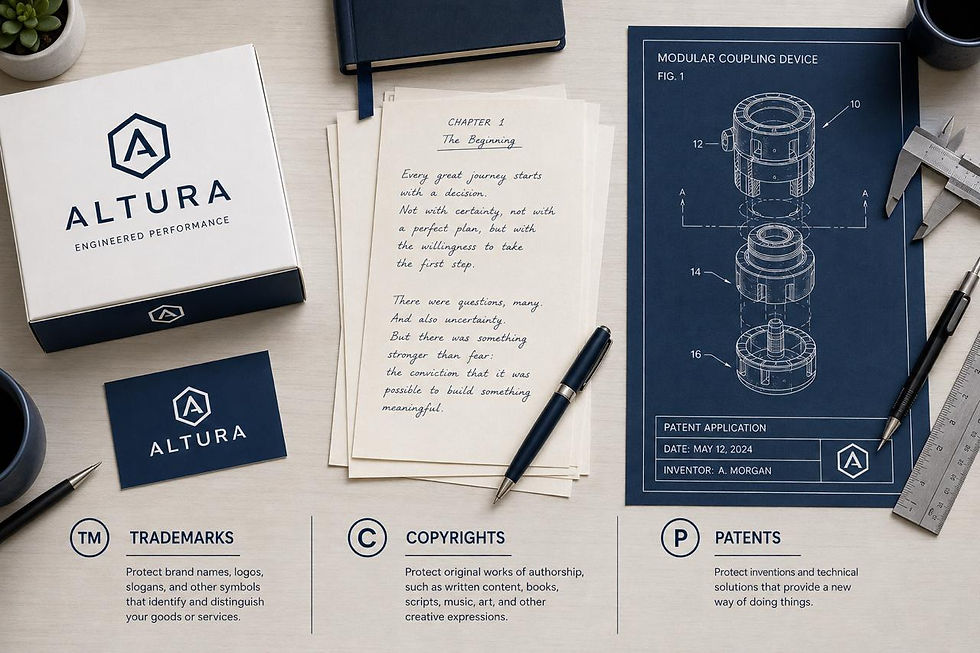
A trademark protects the identifiers that tell consumers who is behind a product or service. That includes your business name, your logo, your slogan, and in some cases even distinctive colors, sounds, or packaging. The key question trademark law asks is: does this element identify the source of the goods or services? If yes, it may be protectable as a trademark.
Trademark rights arise from actual use in commerce — the moment you start using a name or logo to sell products or services, you begin building common law trademark rights in your geographic area. Federal registration with the USPTO significantly expands those rights, giving you nationwide priority and the ability to use the ® symbol.
A registered trademark lasts indefinitely, as long as you continue using it and renew it with the USPTO at the required intervals (between the 5th and 6th year, then every 10 years after that).
A Copyright Protects Your Creative Work
A copyright protects original creative expression — the specific way something is written, drawn, photographed, filmed, coded, or composed. Copyright covers things like blog posts, books, website copy, photographs, videos, music, artwork, and software code.
Here is the most important thing to understand about copyright: it arises automatically. The moment you create an original work and fix it in a tangible form — type it, record it, save it — copyright protection attaches. You do not need to register it. You do not need to put a © symbol on it (though doing so is smart practice).
However, registration with the U.S. Copyright Office matters for enforcement. If someone infringes your copyright and you want to sue, you generally need a registration on file to claim statutory damages and attorney’s fees — the remedies that make litigation worth pursuing. For works you rely on commercially, registration is strongly recommended.
Copyright duration for works created by an individual lasts the author’s lifetime plus 70 years. For works created by a corporation or as works for hire, the term is 95 years from publication.
A Patent Protects Your Invention
A patent protects novel inventions — new products, new processes, new machines, or new compositions of matter. If you have created something genuinely new that did not exist before and that meets the legal standards for patentability, a patent gives you a temporary monopoly: the exclusive right to make, use, sell, and license that invention for a set period of time.
Unlike copyright, patents do not arise automatically. You must apply for a patent with the USPTO, and the process is lengthy, expensive, and technically demanding. Most utility patent applications — the most common type — take two to five years to process and cost anywhere from $5,000 to $15,000 or more in attorney and filing fees. Utility patents last 20 years from the filing date, after which the invention enters the public domain.
Design patents, which protect the ornamental appearance of a product rather than its function, are faster and less expensive to obtain, and last 15 years.
How They Compare — Side by Side
Factor | Trademark | Copyright | Patent |
What it protects | Brand identifiers — names, logos, slogans, trade dress | Original creative works — writing, art, music, code, photos | Novel inventions — products, processes, machines, designs |
Arises automatically? | Partial — common law rights from use; federal registration strengthens them | Yes — from the moment of creation in fixed form | No — requires formal application and USPTO approval |
How long does it last? | Indefinitely, with continued use and renewal | Life of author + 70 years (or 95 years for corporate works) | 20 years from filing (utility); 15 years (design) |
Where to register | USPTO | U.S. Copyright Office | USPTO |
Approx. cost to register | $350+ per class of goods/services | $35–$65 to file online | $5,000–$15,000+ in attorney and filing fees |
Real-World Examples for Business Owners
The differences between these three types of protection become clearer when you apply them to real business situations. Here are some of the most common scenarios:
You launch a clothing brand. The brand name and logo are candidates for trademark registration. The product photos on your website are protected by copyright automatically. If you develop a new fabric technology, that would be a separate patent matter entirely.
You write a book about your industry. The text, structure, and expression in the book are protected by copyright from the moment you write it. The title of a single book is generally not registrable as a trademark (though a series title can be).
You develop a mobile app. The underlying code is protected by copyright. The app’s name and logo are candidates for trademark registration. If the app contains a genuinely novel technical process, you may have patent-eligible subject matter worth evaluating.
You create a jingle for your business. The music and lyrics are automatically protected by copyright. If that jingle also functions as a brand identifier — customers hear it and immediately think of your company — it may also be registrable as a sound trademark.
You design a unique product package. If the packaging has creative design elements, those may be protected by copyright. If the packaging’s distinctive appearance identifies your brand to consumers, it may be protectable as trade dress — a form of trademark protection.
Can You Have All Three?
Yes, and many businesses do. These three types of protection are not mutually exclusive. They protect different aspects of a business, and a single company can hold all three simultaneously for different things it creates.
Consider a company that makes a branded line of kitchen appliances. The company name and product logo are registered trademarks. The instruction manual and product photography are protected by copyright. A novel mechanism inside one of the appliances is protected by a utility patent. Each form of protection covers a different layer of what the company owns.
The important distinction is that these protections do not overlap. A trademark registration does not protect your product photos. A copyright on your marketing materials does not protect your brand name. Getting clear on what each type covers — and what it does not — is essential to building a comprehensive IP strategy.
Which One Does Your Business Actually Need?
For the vast majority of small and mid-sized businesses, trademark registration is the most immediately important step. Your brand name and logo are the assets that drive customer recognition, referrals, and repeat business. Protecting them with a federal trademark registration gives you nationwide priority and legal recourse if a competitor copies them.
Copyright protection arises automatically for your creative work, but if you produce content commercially — photography, writing, video, software — registering those copyrights with the U.S. Copyright Office gives you significantly stronger enforcement tools.
Patents are relevant only if you have created a novel invention that meets the legal standards for patentability. Most service businesses, retail brands, and content creators do not need patents. If you believe you may have a patentable invention, the first step is an evaluation by a licensed patent attorney — patent law is highly technical, and the application process does not forgive errors.
The most common and costly mistake business owners make is assuming that one type of protection covers everything. Registering your business name with the state does not give you trademark rights. Printing your logo on a product does not give you a patent. Understanding the boundaries of each type of protection is what allows you to use them effectively.
Frequently Asked Questions About the Difference Between a Trademark, Copyright, and Patent
Does registering my business name with my state protect my brand?
No. State business registration and trademark registration are completely separate legal processes. Registering your LLC or corporation with the state gives you the right to operate as a legal entity under that name in that state — it does not give you trademark rights and does not prevent someone else in your industry from using a similar name. Federal trademark registration through the USPTO is what protects your brand name in commerce.
Is my logo automatically protected when I create it?
If your logo contains original creative elements, it is protected by copyright from the moment it is created — automatically, without registration. However, copyright and trademark protection serve different purposes. Copyright protects the logo as a creative work; trademark registration protects the logo as a brand identifier, giving you the exclusive right to use it in your industry nationwide. For most businesses, trademark registration is the more commercially valuable protection.
Do I need a patent if I already have a trademark?
Not unless you have an invention to protect. Trademarks protect brand identity; patents protect inventions. These cover completely different things and are obtained through separate processes. Most businesses that register trademarks will never need a patent. If you have developed a novel product, process, or technology, a patent attorney can evaluate whether you have patent-eligible subject matter.
Can I trademark a book title?
Generally, the title of a single book is not registrable as a trademark. The USPTO typically views a single title as identifying one creative work rather than functioning as a brand identifier in commerce. The text of the book itself is protected by copyright. However, titles of a series of books — where the title functions as a brand across multiple products over time — can qualify for trademark protection.
If someone copied my logo, is that a trademark or copyright issue?
Potentially both, depending on how it was copied and how it is being used. If a competitor is using a similar logo in a way that could confuse consumers about the source of goods or services, that is trademark infringement. If they reproduced your actual logo file without authorization, that may also constitute copyright infringement. The two claims are not mutually exclusive, and an attorney can help you determine which is stronger based on the specific facts.
How much does trademark registration cost compared to copyright and patent?
Trademark registration with the USPTO starts at approximately $350 per class of goods or services, plus attorney fees. Copyright registration is the most affordable, running around $35 to $65 to file online through the Copyright Office. Patent applications are by far the most expensive — utility patents typically require $5,000 to $15,000 or more in combined attorney and USPTO fees, and the process can take several years from filing to grant.
What happens if I use the wrong type of IP protection for my business?
At best, you waste money on protection that does not cover what you actually need. At worst, you leave your most valuable assets unprotected while spending resources on the wrong filing. The most common version of this mistake is relying on state business registration instead of trademark registration — leading business owners to discover too late that a competitor has filed a federal trademark for the same name and has superior rights nationwide.
When Do You Need a Trademark Lawyer?
Understanding the difference between trademark, copyright, and patent is the first step. Knowing which ones apply to your specific business — and making sure you pursue them correctly — is where professional guidance makes a real difference.
At Brand Diplomacy, we work with business owners to identify which intellectual property protections actually matter for their brand, secure those protections through the correct legal channels, and enforce them when someone else crosses the line. Trademark law is where we specialize, and we know how to build a strategy that protects your brand now and as you grow.
Our team provides complete trademark legal representation so you can focus on what matters most — growing your business with confidence.
To schedule an appointment with experienced trademark attorney Melissa Ramnauth, please visit our booking page by clicking here or call our office at (754) 800-4481. We look forward to assisting you!
Further Reading
Our team provides complete trademark legal representation so you can focus on what matters most—growing your business with confidence.

To schedule an appointment with experienced trademark attorney Melissa Ramnauth, please visit our booking page by clicking here or can call our office at (754) 800-4481. We look forward to assisting you!


Book a call now by clicking here or call our office at (754) 800-4481!
Legal Disclaimer
Your use of the content on this site or content from our email list is at your own risk. The use of this website does not create an attorney-client relationship. Brand Diplomacy does not guarantee any results from using this content and it is for educational purposes only. It is your responsibility to do your own research, consult, and obtain a professional for your medical, legal, financial, health, or other help that you may need for your situation.
The information on Brand Diplomacy is “as is” and makes no representations or warranties, express or implied, with respect to the content provided on this website or on any third-party website which may be accessed by a link from this Web site, including any representations or warranties as to accuracy, timeliness, or completeness. Brand Diplomacy will not be liable for any losses, injuries, or damages from the display or use of this information.
All information on this website is accurate and true to the best of Brand Diplomacy's knowledge, but there may be omissions, errors or mistakes. Brand Diplomacy is not liable for any damages due to any errors or omissions on the website, delay or denial of any products, failure of performance of any kind, interruption in the operation and your use of the website, website attacks including computer virus, hacking of information, and any other system failures or misuse of information or products.
Brand Diplomacy does not write sponsored posts or accept free products for review. All thoughts and opinions written by Brand Diplomacy is our own.
Brand Diplomacy welcomes comments on blog posts. All comments submitted to us are the opinions of the author and do not necessarily reflect or represent the views, policies, or positions of this site. We reserve the right to use our own discretion when determining whether or not to remove offensive comments or images.


Comments